
Music
Create what moves you
At LaGrange College, studying music means becoming part of a close-knit creative community where mentorship, collaboration, and real-world experience shape your growth as an artist. Whether you’re drawn to performance, production, or musical theatre, you’ll work alongside faculty and fellow students to develop your craft in studios, rehearsal halls, and on stage. Through hands-on learning and meaningful collaboration across the arts, LaGrange helps you turn your passion for music into a purposeful path forward.
Choose your path in Music
At LaGrange College, music students can pursue three distinct degree paths depending on their interests—from performance and theatre to music production and audio engineering.
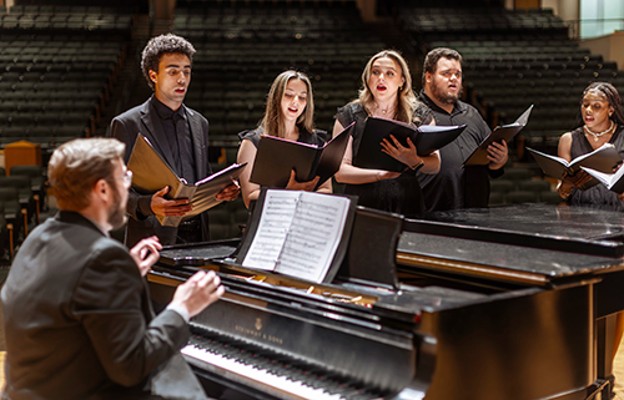
The Bachelor of Music in Music Production and Audio Engineering prepares students for careers in today’s music industry as songwriters, producers, and audio engineers. Through hands-on work in professional studios, students learn modern production techniques, industry-standard recording practices, and the tools used by working professionals. Students develop skills in songwriting and music production across multiple genres, including audio engineering, recording techniques, mixing, and mastering with industry-standard digital audio workstations. Modern music business entrepreneurship and marketing is integrated to prepare students for the rapidly evolving landscape in the music industry.
The Bachelor of Music in Film and Media Scoring equips students with the creative, technical, and collaborative skills needed to compose and produce music for today’s evolving media industries. Through intensive study in composition, orchestration, music technology, audio production, and storytelling, students learn how music shapes emotion and narrative across visual and interactive media. The program’s interdisciplinary environment encourages collaboration with filmmakers, media artists, and performers, giving students hands-on experience scoring real-world creative projects.
The Bachelor of Arts in Musical Theatre prepares students for the stage through training in the three essential elements of musical theatre: music, acting, and dance. Students gain experience through multiple performance opportunities while studying the history and literature of musical theatre.
The Bachelor of Arts in Music offers a broad, liberal arts–based music education that allows students to develop their musical skills while exploring complementary areas of study across campus. Students are encouraged to pair the degree with a minor that supports their interests and career goals.
Majors and Minors
Major Minor
B.A. in Music B.M. in Music Production and Audio Engineering Minor in Music B.M. in Film and Media ScoringCourses
Beginning instruction in piano for music majors with no previous keyboard training. Development of basic reading skills. Open to non-majors with the approval of the instructor.
Individual instruction in the students area of discipline to develop technical proficiency, portfolio material, and live performance opportunities. May be repeated for credit. Section codes are as follows: Voice (A), Guitar (D), Music Production & Audio Engineering (P), Film & Media Scoring (Q).
Performance organization(s) providing ensemble experience. May be repeated for credit. Section codes are as follows: LC Singers (A), LC Performance Ensemble (G).
Performance organization(s) providing ensemble experience. May be repeated for credit. Section codes are as follows: LC Singers (A), LC Performance Ensemble (G).
A broad survey of American music and musical technology from the late 1700s to present.
A broad survey of music aimed at developing aesthetic awareness and critical analysis of music from several historical periods beginning with medieval music and continuing up through the 21st century.
This course focuses on basic elements of music theory and is designed to provide the student with the foundation of music theory. Topics include scales, key signatures, simple and compound meters, intervals, triads, and seventh chords. Some lab time will be devoted to Internet music resources and notation using MuseScore.
Continuation of MUSI 1501. This course focuses on Diatonic Harmony and is designed to extend the student’s basic understanding of music theory. Topics include elementary counterpoint, elementary part writing, secondary dominants, secondary diminished seventh chords. Some lab time will be devoted to Internet music resources and notation using MuseScore. Other topics will include music analysis.
Continuation of Piano 1 with additional emphasis on sight-reading and performance.
Ear Training I introduces basic aural skills, including interval recognition, melodic andrhythmic dictation, and sight-singing. Students develop fundamental listening abilities thatsupport concepts learned in Music Theory I
Topics covered include: basic vocal technique, vocal anatomy, breath management, maintaining vocal health, vocal registers, theatrics of singing, IPA, and basic score reading.
This course trains students in the use of the International Phonetic Alphabet to pronounce foreign language art songs and arias. Emphasis is on IPA symbols applied to English, Italian, German, and French.
Classroom instruction in digital and analog audio engineering. Recording console operation, microphone placement and usage, mixing, tape based and hard disc recording, mastering, CD burning and troubleshooting.
This course advances students’ skills in music production within a digital audio workstation (DAW) environment emphasizing the creative use of virtual instruments, software plugins, MIDI programming, and sound design techniques. Students will develop professional-level production workflows, focusing on arranging, mixing, and producing original music.
This course introduces students to the art and craft of composing music for film, television, video games, and other media with special emphasis on how music enhances narrative, mood, and emotional impact. Students will learn to analyze visual media, create original musical sketches, and develop scoring techniques using digital audio workstations, virtual instruments, audio recording, and sample libraries.
This course builds on the foundational scoring skills by exploring music composition for an array of media, including short films, documentaries, animation, and podcasts. Students will further develop DAW-based production skills, thematic composition, sound design, and synchronization techniques, while refining collaborative skills.
(1-6 hours) An opportunity for students to gain added early applied experience and insight in approved off-campus settings. Internships consist of at least 40 working hours per credit hour in areas related to the discipline. Assignments may include selected readings, public presentation, and a final portfolio containing essays, weekly journal, and supporting material. Advisors, program coordinators, department chairs, and the internship coordinator (or designee) must approve the internship before a student begins their work. Internships will be taken as pass/no credit.
Individual instruction in the students area of discipline to develop technical proficiency, portfolio material, and live performance opportunities. May be repeated for credit. Section codes are as follows: Voice (A), Guitar (D), Music Production & Audio Engineering (P), Film & Media Scoring (Q).
Individual instruction in the student’s choice of instrument or voice to develop technical proficiency, repertoire knowledge, and performance skills. May be repeated for credit. (N.B., Composition does not count as a primary applied instrument for degree completion. Refer to “Primary Applied Instrument” above.) Section codes are as follows: Voice (A), Piano (B), Organ (C), Guitar (Classical and Contemporary)(D), Percussion (E), Applied Composition and Sound Design (F), Strings (G), Flute (H), Clarinet (I), Oboe (J), Saxophone (K), Trumpet (L), Trombone (M), Euphonium (N), Horn (O)
Performance organization(s) providing ensemble experience. May be repeated for credit. Section codes are as follows: LC Singers (A), LC Performance Ensemble (G).
Performance organization(s) providing ensemble experience. May be repeated for credit. Section codes are as follows: LC Singers (A), LC Performance Ensemble (G).
Class instruction for musical technology topics of a highly specialized nature. Topics will focus on music technologies used in commercial music. The content of this course will change based upon the expertise of the instructor and the needs of the students. Topics include, but are not limited to, microphone techniques, music notation software, live sound reinforcement, on-the-fly multi-media presentation software, Ableton Live, etc. May be repeated for credit.
Conducting techniques, score reading, rehearsal techniques for choral and/or instrumental ensembles.
Continuation of MUSI 2113.
This course provides students with exposure to current issues, trends, and opportunities in the music and entertainment industries through weekly presentations, guest lectures, and panels with professionals from diverse areas of the field. Students will explore career pathways, industry practices, and networking strategies.
This course explores the creation and production of music tailored for live sporting events and other media contexts. Students learn to compose, arrange, and produce music that enhances energy, atmosphere, and audience engagement. Emphasis is placed on understanding the relationship between music and audience experience, timing, and synchronization with live or recorded media, and practical production techniques.
This course engages students in collaborative research-driven podcast creation. Working in interdisciplinary teams, students develop, research, script, record, and produce a series of three polished podcast episodes. There is an emphasis on storytelling, audio production, research communication, and teamwork in a professional-style media environment.
A special projects course with hands-on participation and teamwork required. Each project is unique; specific content will be publicized in the semester preceding the course offering.
Class instruction for musical topics of a highly specialized nature. The content of this course will change based upon the expertise of the instructor and the needs of the students. May be repeated for credit.
The capstone presentation is a senior-level exploration of a faculty-approved music topic.
Approval of instructor.
(1-6 credits) A supervised, practical “real world” experience in a professional off-campus environment. May be repeated for credit. Internships consist of at least 40 working hours per credit hour in areas related to the discipline. Advisors, program coordinators, department chairs, and the internship coordinator (or designee) must approve the internship before a student begins their work.


